
Last Updated: November 3, 2026
Quick Summary
Transparent bible study for atheists means reading scripture to understand it, not to be moved by it. Keep scripture and commentary in separate, clearly marked voices, read a passage cold before any notes, and keep a doubt log so questions are recorded rather than resolved in advance.
- Read a passage cold first, then read commentary while marking whose voice it is.
- A non-religious guide should explain content, history and reception without requiring any theological claim.
- Pick one word-for-word and one thought-for-thought translation and compare a chapter side by side.
- Start with Genesis, Exodus, a Gospel and the Psalms instead of pushing straight through Leviticus.
- Twenty minutes a day covers the six-week reading plan in the article.
Table of Contents
- Bible Study for Skeptics: Reading Scripture Without a Devotional Agenda
- What a Non-Religious Bible Study Guide Should Actually Contain
- Reading the Atheist Bible Online: Tools, Translations and Podcasts
- Frequently asked reader questions
- Frequently Asked Questions
Bible Study for Skeptics: Reading Scripture Without a Devotional Agenda
Transparent bible study for atheists means reading scripture to understand it, not to be moved by it. The Next Testament pairs the full text of a published translation with commentary written by an AI, so you can weigh an interpretation instead of absorbing it.
Much Bible material assumes you want to be persuaded: devotionals aim at feeling, sermons aim at a decision, and some study notes nudge toward a conclusion before you've formed one.
The fix is structural: scripture and interpretation must sit in separate, clearly marked voices, with nothing smoothed over to protect a conclusion.
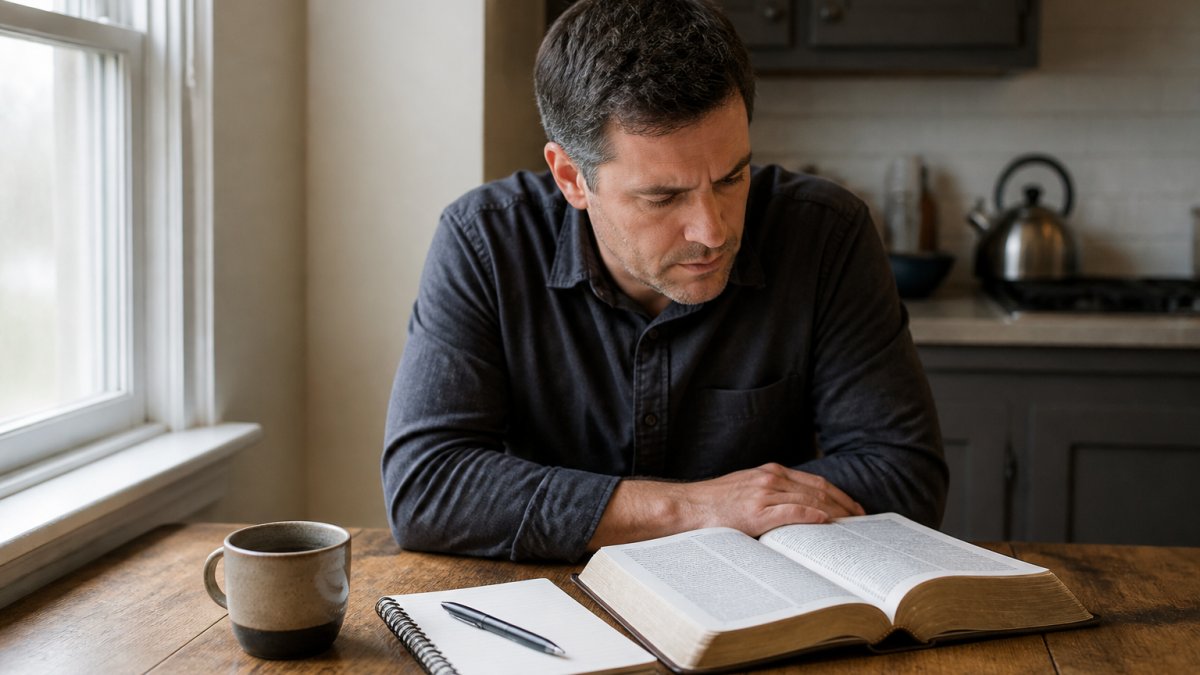
Start with three habits:
- Read a passage cold first. No notes; write down what it says and assumes.
- Then read commentary, marking whose voice it is. If you can't tell where scripture ends and interpretation begins, the edition has failed you.
- Keep a doubt log. One line per question; answers come later.
Skepticism is a method, not a destination. Deciding in advance that everything is fraud or revelation stops the study; asking what the text says, who wrote it, and what it did in its own century is the actual work.
What a Non-Religious Bible Study Guide Should Actually Contain
A non-religious Bible study guide explains the text's content, history, and reception without requiring any theological claim. The test: could a religious reader and an atheist use it, disagree about conclusions, and agree about accuracy?
Separation of voices. Scripture and commentary must be structurally distinct; if you can't tell Genesis from a note about Genesis, you'll blur them in memory too.
Coverage of hard passages. Watch how it treats the flood narrative, the conquest accounts, Leviticus, and the ending of Mark. A guide that softens difficult material is telling you what it's protecting.
Named method. Historical-critical, literary, and reception-history readings are different tools with different blind spots. Transparency about method is the best predictor of whether a resource respects your judgment.
Honest labeling of consensus versus conjecture. A guide that presents both with equal confidence is misleading you, gently.
No altar call. The material shouldn't end every section asking what this means for your walk. You're reading a document, not joining a congregation.
- Are scripture and commentary visually distinct?
- Does the guide state its method and limits?
- Are scholarly disagreements flagged?
- Are difficult passages handled or skipped?
- Is the translation named and modern?
- Can you read a chapter without being told how to feel?
One entry point is a hard narrative handled well. Read the flood narrative with commentary and see whether the notes explain the older regional flood stories or quietly avoid them.
Reading the Atheist Bible Online: Tools, Translations and Podcasts
An atheist Bible online is a digital edition you can read critically: searchable text, visible verse numbers, a named translation, and commentary you can switch off.
Translation choice matters. Word-for-word translations keep original sentence structure, useful for close reading but stiff; thought-for-thought translations are smoother but make interpretive choices for you.
An atheist Bible study podcast offers exposure to how other nonbelievers read a passage, plus company through genealogies. Treat it as a supplement: a host's summary is commentary and deserves the same scrutiny as a printed note.
For the Ten Commandments, read the Sinai account in full rather than the excerpted version, the framing around the commands is where most of the argument sits.
Watch out: the biggest time sink for new readers is starting at Genesis and pushing straight through. Leviticus stops most people cold. Read in this order instead: Genesis, Exodus, a Gospel, the Psalms, then jump wherever your questions pull you.
| Week | Reading | Time per day | Goal |
|---|---|---|---|
| 1 | Genesis 1-11 | 20 min | Creation and flood narratives |
| 2 | Genesis 12-50 | 20 min | Patriarch stories, literary structure |
| 3 | Exodus 1-20 | 20 min | Slavery, liberation, law |
| 4 | One Gospel, start to finish | 25 min | Compare against the others |
| 5 | Psalms, selected | 15 min | Poetry, lament, praise |
| 6 | A hard book of your choice | 20 min | Apply the checklist above |
Twenty minutes a day can get a reader through the material covered in the plan above in about six weeks, a real commitment.
Frequently asked reader questions
Do I need to believe anything to study the Bible? No. Critical study requires attention and honesty, not assent; you can analyze its claims, sources, and history like any ancient document.
Which translation should a nonreligious reader start with? A modern translation you can read comfortably, then compare a second on the same chapter to see where interpretation is doing the work.
How do I tell historical evidence from scholarly consensus from a faith claim? Ask what the claim rests on: evidence is checkable, consensus is the current majority view and can change, and a faith claim rests on revelation, different in kind, not necessarily false.
Reading the Bible without a devotional agenda is harder than it sounds, mostly because so few resources are built for it. The Next Testament is built for that reader: the complete text of a published translation alongside 834,714 words of commentary written by Claude AI with no doctrinal direction, kept in two distinct voices so you can tell scripture from interpretation. It includes 80 book introductions and 673 section meanings.
Frequently Asked Questions
Is there a good Bible study for atheists?
Yes, but it depends on what you want from it. A useful bible study for atheists keeps scripture and interpretation visibly separate, states its perspective up front, and does not assume you accept any doctrinal claim. Look for a published translation printed in full, commentary that explains its method, and book introductions that give historical context. Resources like The Next Testament pair the complete text with clearly labelled commentary, so you can read the verse and the analysis as two separate voices and judge the interpretation yourself.
How can an atheist study the Bible without religious bias?
Start by choosing a resource that separates the biblical text from the commentary, then read each passage before you read anyone's explanation of it. Note what the verse says, what genre it belongs to, and who wrote it and when. When you do read commentary, check whether it tells you its perspective and whether it distinguishes historical evidence from scholarly consensus from faith claims. A non-religious Bible study guide should make those distinctions explicit rather than blending them into one voice.
Are there Bible study podcasts for atheists and skeptics?
Several podcasts approach scripture from a secular or skeptical angle, usually moving book by book and discussing historical context alongside the text. When evaluating an atheist Bible study podcast, check whether the hosts name their perspective, whether they cite sources, and whether they read passages in full rather than excerpting verses. Podcasts work well as a companion to reading, but they cannot replace the text itself, so keep a translation open while you listen and compare what the hosts say with what the page actually says.
