
Last Updated: November 16, 2026
Quick Summary
Evaluate Bible commentaries by checking author credentials, stated audience, how fully they treat the biblical text, evidence quality, clarity of reasoning, theological perspective, and usefulness for your task. Apply these criteria to a specific passage by opening two volumes to the same chapter and comparing them side by side.
- A commentary is a reference work written by a person with a point of view, not scripture.
- Single-volume commentaries suit quick reference, while book-length commentaries go deep on one book.
- The biggest mistake is judging a commentary by its conclusion instead of its reasoning.
- For sermon prep, pair one expository commentary with one sermonic commentary.
- Read the scripture itself plainly before consulting the commentary.
Table of Contents
- Types of Bible Commentaries and What Each One Does
- Bible Commentary Evaluation Criteria That Actually Work
- How to Choose a Bible Commentary for Your Task
- Frequently Asked Questions
Types of Bible Commentaries and What Each One Does
Evaluating types of Bible commentaries starts with one fact: a commentary is written by a person with a point of view. Keeping scripture and commentary in separate voices helps prevent readers from getting confused.
A Bible commentary is a reference work that explains a biblical text through historical context, literary analysis, and interpretation. It is not scripture.
| Type | Best For | Strength | Limitation |
|---|---|---|---|
| Technical / exegetical | Language study, research | Depth on original text | Assumes Greek or Hebrew |
| Expository | Sermon prep, teaching | Clear passage flow | Less on technical detail |
| Pastoral / devotional | Personal Bible study | Warmth and application | Lighter on scholarship |
Single-volume commentaries suit quick reference; book-length commentaries go deep on one book, and a series usually holds a consistent editorial stance.
Bible Commentary Evaluation Criteria That Actually Work
Most readers pick a commentary by reputation or cover design. That is the wrong order. Seven checks, run in sequence, separate a useful volume from a decorative one fast.
- Author and editor credentials. Who wrote it, what do they research, and what is their stated aim?
- Stated audience. Pastors read differently from graduate students; check the series description.
- Treatment of the biblical text. Does the author quote the passage fully, or skip complicating verses?
- Evidence quality. Are claims tied to manuscripts and cited scholarship, or just asserted?
- Clarity of interpretation. Can you follow the reasoning from text to conclusion without gaps?
- Theological perspective. What tradition does the author write from, and do they say so?
- Usefulness for your task. Does it answer the question you actually brought?
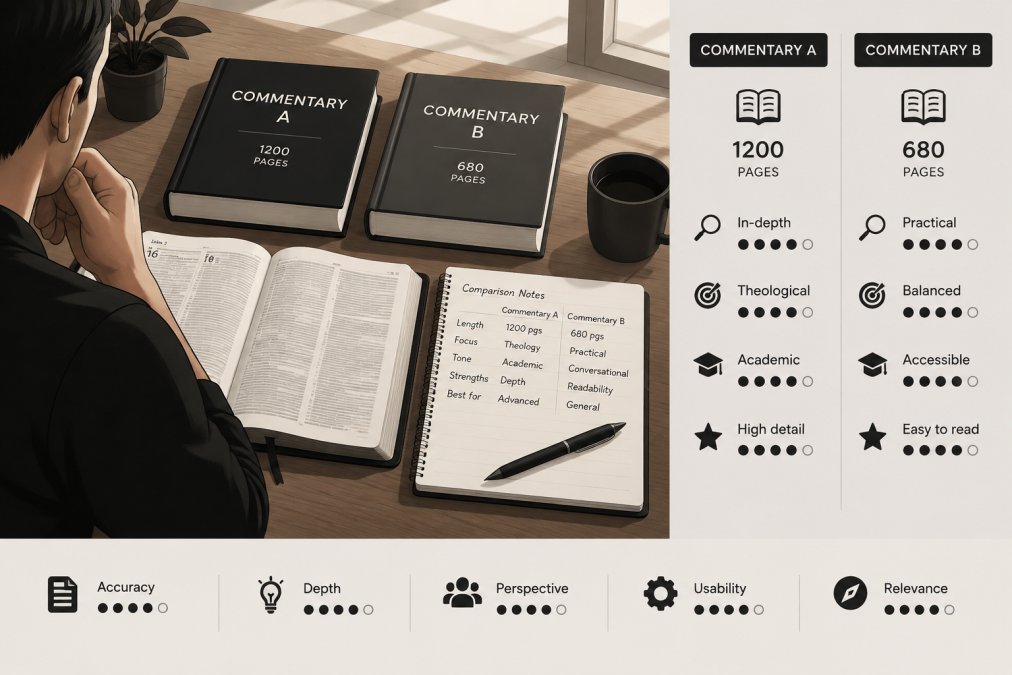
Bible commentary evaluation criteria only work if you apply them to a specific passage: open two volumes to the same chapter and compare. The biggest mistake is judging a commentary by its conclusion instead of its reasoning. For a worked method, see how to keep scripture and commentary clearly separated.
How to Choose a Bible Commentary for Your Task
The right commentary depends on what you are doing, not on which one ranks highest.
- Personal Bible study: start with a pastoral or devotional commentary, then add one expository volume for structure.
- Sermon or lesson preparation: pair one expository commentary with one sermonic commentary.
- Academic research: go to technical and critical commentaries, and check the bibliography before the prose.
- Teaching a group: pick a commentary with clear section breaks you can summarize aloud.
Print volumes are easier to annotate and compare side by side; digital editions win on search and portability, and library access lets you test a series before buying. Publishers such as Zondervan Academic publish series descriptions that state each volume's intended audience.
Bible commentary theological bias is not a flaw to eliminate but a fact to identify. Read the preface, check which scholars the author cites, and note which disputed passages get soft treatment. The Chicago Statement on Biblical Hermeneutics sets out how one tradition frames interpretation rules, showing you the assumptions behind a commentary before you meet them mid-argument.
Then read the scripture itself, plainly, before the commentary. The Next Testament presents full scripture text in a published translation, with AI-written commentary kept in a separate voice, so you can weigh interpretations for yourself.
Sorting commentaries is really a discipline in reading carefully. The harder challenge is holding the text and the interpretation apart while you do it. The Next Testament was built for that: every verse printed whole, commentary written by Claude AI with no doctrinal direction, 80 book introductions, and 673 section meanings kept in a distinct voice from scripture. Get started with The Next Testament and read the Bible with the commentary beside it, not over it.
Frequently Asked Questions
What are the two main categories of Bible commentaries?
Most commentaries split into two broad camps: technical or exegetical works, which dig into original languages, textual variants and historical context, and pastoral or devotional works, which focus on meaning and application for the reader. Within those camps you also find expository, sermonic and homiletical commentaries aimed at preachers. Knowing which camp a volume belongs to tells you quickly whether it will answer a language question or a life question, and stops you buying the wrong tool for the task.
How can you identify theological bias in a Bible commentary?
Read the introduction before the commentary itself. Authors usually state their tradition, their view of scripture and their method. Then test the body: check whether the writer engages views they disagree with fairly, whether they cite evidence for contested claims, and whether difficult passages get explained or skipped. Bible commentary theological bias rarely hides, it just goes unlabelled. Comparing two commentaries on the same passage from different traditions makes the assumptions visible fast, and that comparison habit is the most reliable check you have.
Should you use more than one Bible commentary on the same passage?
Yes, and two is usually enough. Read the passage yourself first, then consult a technical commentary for context and language issues and a pastoral one for application. Where they disagree, note why: different evidence, different tradition, or different audience. That disagreement is often the most useful part of the exercise, because it shows you which interpretive choices are genuinely contested and which are settled. Evaluating Bible commentaries works best as a comparison, not a search for one authoritative voice.
