
Last Updated: November 17, 2026
Quick Summary
To compare Bible translations verse by verse, pick short test passages like Genesis 1:1 or John 1:1, line up three versions from different families (formal, dynamic, paraphrase), and mark where wording shifts. Read each aloud, look up disputed words in an interlinear or lexicon, and log findings in a three-column note.
- Choose test passages that stress translation choices: narrative, poem, legal list, and dense theology.
- Pick one formal, one dynamic, and one paraphrase translation rather than three of the same approach.
- Reading each version aloud exposes rhythm and syntax differences that silent reading hides.
- Check an interlinear or lexicon for the underlying Greek or Hebrew term of disputed words.
- Build your own chart from at least four passages before drawing conclusions.
Table of Contents
- Compare Bible Translations Side by Side: A Step-by-Step Method
- Bible Comparison Chart: What the Columns Actually Tell You
- Bible Translation Comparison Chart PDF: How to Read and Use One
- Frequently Asked Questions
Compare Bible Translations Side by Side: A Step-by-Step Method
Learning how to compare Bible translations verse by verse shows what a translation does with the text. Pick a short passage, line up several versions, and note where wording shifts, about twenty minutes per passage.
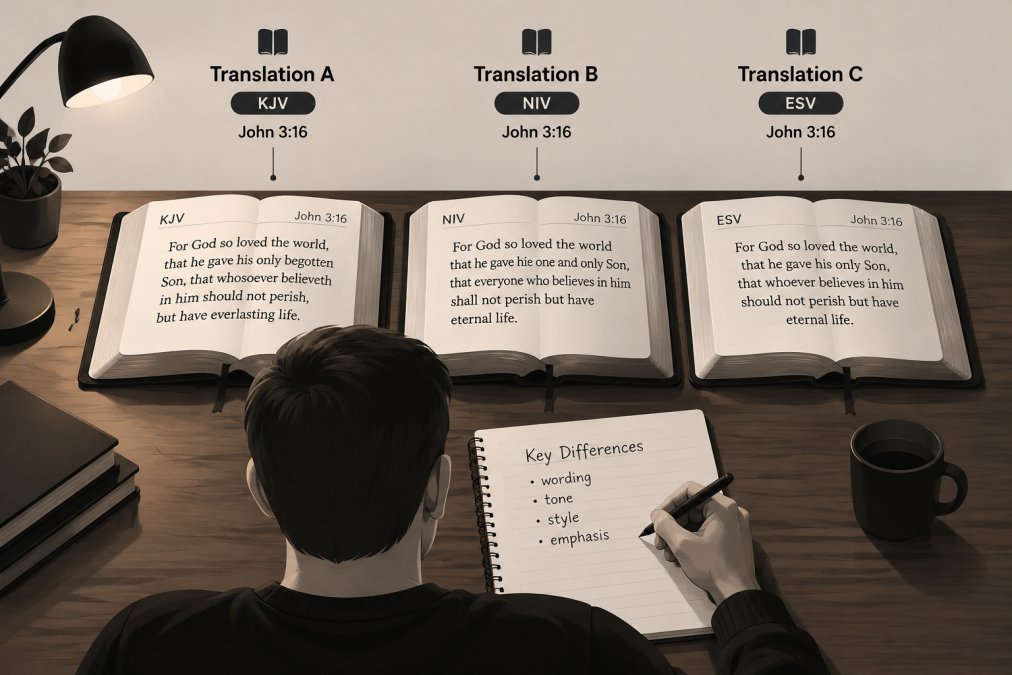
Step 1: Pick your test verses. Choose passages that stress translation choices: a narrative scene, a poem, a legal list, and one dense theological sentence. Common test verses include Genesis 1:1, Psalm 23:1, John 1:1, and Romans 3:23.
Step 2: Choose three translations from different families. One formal, one dynamic, and one paraphrase reveal more than three brands of the same approach.
Step 3: Read each version aloud. Reading aloud exposes rhythm and syntax differences that silent reading hides.
Step 4: Mark the differences. Underline changed verbs, note added or dropped phrases, and flag words unique to one version.
Step 5: Look up the disputed words. Check an interlinear or lexicon for the underlying Greek or Hebrew term. This is where the real comparison happens.
Step 6: Record your findings in a simple log. A three-column note (verse, version, observation) keeps your study honest and repeatable.
To sharpen your eye for literary structure, our companion guide on how to read the Bible as literature pairs well with this method.
| Family | Approach | Typical Feel | Best For |
|---|---|---|---|
| Formal equivalence | Word-for-word | Closer to original syntax | Close textual study |
| Dynamic equivalence | Thought-for-thought | Smoother modern English | General reading |
| Paraphrase | Free restatement | Highly readable | Quick overview |
Bible Comparison Chart: What the Columns Actually Tell You
Most comparison charts list versions across the top and verses down the side. The columns reveal translation philosophy, not just wording: formal equivalence tracks original sentence structure, dynamic equivalence prioritizes meaning and readability.
Watch out: a chart showing only one verse per book can mislead you. Build your own chart from at least four passages before drawing conclusions.
Bible Translation Comparison Chart PDF: How to Read and Use One
A downloadable Bible translation comparison chart PDF is useful only if you know what its columns measure. Use the PDF as a starting map, then verify claims against the publisher's own introduction.
Keep a printed chart beside your desk, mark the versions you own, and note which ones you have compared on a real passage. A chart is a reference, not evidence.
For a broader look at how translations differ, the CSB verse comparison chart shows selected passages side by side, and Bible Gateway's guide to side-by-side comparison explains how to view multiple versions at once. If you want a focused single-verse tool, Bible Hub works well for quick checks.
The Next Testament brings the full text of a published translation together with 834,714 words of AI-written commentary from Claude AI, kept in a distinct voice so scripture and analysis remain separate. The commentary includes 80 book introductions and 673 section meanings. Begin reading with The Next Testament.
Frequently Asked Questions
How do I compare Bible translations verse by verse without getting overwhelmed?
Start with one short verse and three translations, not the whole chapter. Read each version aloud, then write down only the words that change. A literal translation, a thought-for-thought version, and a paraphrase give you the widest spread with the least reading. Repeat the same verse in the same three versions for a week before adding more. The goal is a repeatable habit, not a complete survey.
Which online tools let me compare Bible translations side by side?
Pick one comparison tool and learn its layout, and keep your passage list in a separate document so you are not relearning the tool each time.
How can I tell whether a difference between translations is significant?
Ask three questions. Does the change alter who is doing the action? Does it change a key term, such as a word for sin, faith, or covenant? Does it shift the tone from command to suggestion? If the answer is yes to any, the difference matters and is worth checking against a lexicon or an interlinear. If the change is only word order or a synonym, note it and move on. Significance is about meaning, not word count.
