
Last Updated: November 8, 2026
Quick Summary
A bible study guide works best when you read the scripture first and then check the guide's explanation against your own notes. Follow a weekly routine: read the passage twice, note what stands out, compare the guide, answer its questions, and apply one thing.
- Read the passage twice before consulting the guide, once for the big picture and once slowly.
- Write down words, people, or ideas you do not understand before reading the explanation.
- Look for a guide that prints full scripture text and separates commentary from the text.
- Plan one or two chapters per session, with a short review at the end of the week.
- Pick one specific thing to live out each week from your study.
Table of Contents
- How to Use a Bible Study Guide Step by Step
- Choosing a Bible Study Guide Workbook or PDF
- Building a Weekly Plan for Your Next Book of the Bible
- Frequently Asked Questions
How to Use a Bible Study Guide Step by Step
A Bible study guide works best when you treat it as a map, not a script. Most people open one, read the lesson, and skip the scripture. The guide then does the thinking for them. Use it the other way around: read the passage first, then check what the guide says about it.
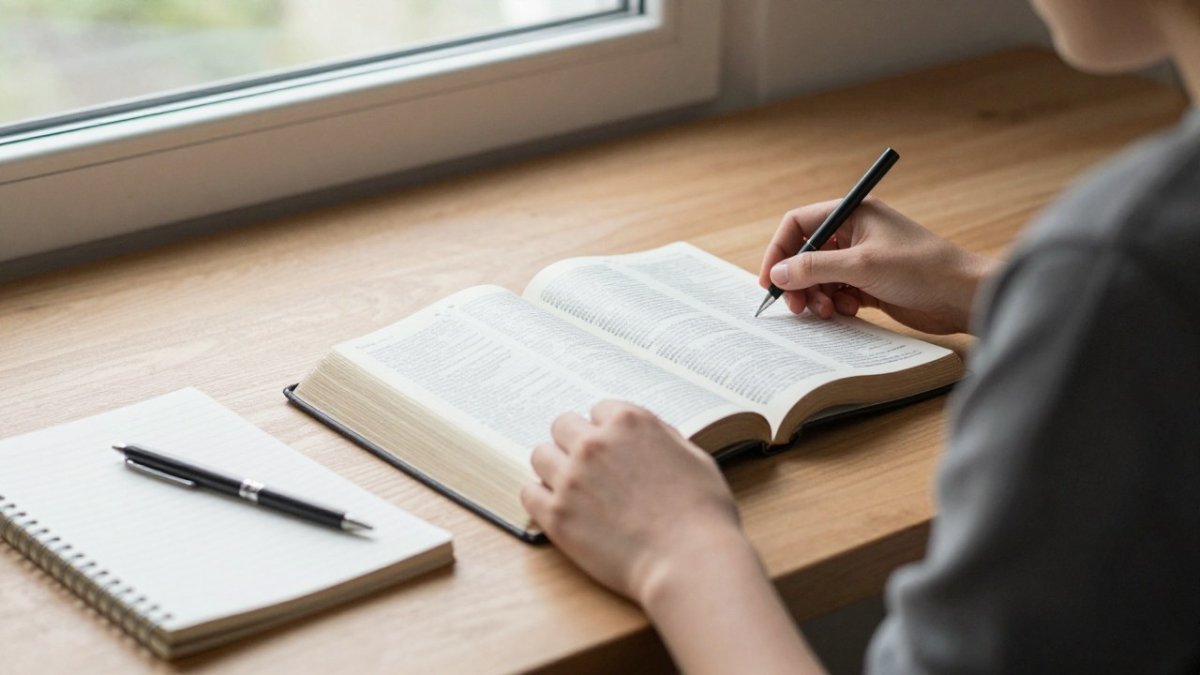
Here is a simple method you can repeat each week:
- Read the passage twice. Once to get the big picture, once slowly for detail.
- Write down what stands out. Note words, people, or ideas you don't understand.
- Read the guide's explanation. Compare it to your own notes.
- Answer the reflection questions. Write short answers in your own words.
- Note one application. Pick one thing to live out this week.
Watch out: skipping step one means you learn the guide's opinions instead of the text itself.
The five-step method below summarises the weekly routine the article recommends.
| Step | What to do | Time or frequency |
|---|---|---|
| Read the passage twice | Once for the big picture, once slowly for detail | Each week |
| Write down what stands out | Note words, people, or ideas you don't understand | Each week |
| Read the guide's explanation | Compare it to your own notes | Each week |
| Answer the reflection questions | Write short answers in your own words | Each week |
| Note one application | Pick one thing to live out this week | Each week |
Choosing a Bible Study Guide Workbook or PDF
Free Bible study guides in PDF form are easy to find. Printed workbooks often offer more space to write. Pick the format that matches how you actually study.
Look for a guide that prints the full scripture text, separates commentary from the text, and lists its sources. Those three features make it easier to check claims for yourself.
Building a Weekly Plan for Your Next Book of the Bible
Pace yourself. A realistic plan for one book is one or two chapters per session, with a short review at the end of the week.
Start with the opening chapters of a book so you see its structure early. For Numbers, the first census and the order of the camp gives you an overview of the opening chapters to pace your first week. Genesis 2:4-25 is one example of a passage that can open a study. For a longer book, plan your weeks in advance so you know where you are headed. For Deuteronomy, the opening address of Moses retelling the journey from Horeb to the plains of Moab is a good place to map out your first week.
If you want to start with the text itself and read it alongside a clear, neutral commentary, The Next Testament presents the complete scripture with separate AI-written commentary. You can begin reading today and decide for yourself how the passages connect.
Frequently Asked Questions
What is the best Bible study guide for beginners?
A good beginner guide is short, moves through one book at a time, and gives a few questions per passage rather than long essays. Look for clear teaching points, a plain reading level and space to write answers. Read the passage first each session, answer the guide's questions in your own words, then compare your notes with the guide. Start with a shorter book such as Ruth or Philippians so you can finish a full study in a few weeks and build the habit before tackling longer texts.
How should a beginner study the Bible?
Begin with a repeatable method: read the passage twice, note what it says, ask what it means in its context, and decide how it applies to you. A bible study guide supports this by supplying questions and context. Keep sessions to 20 to 30 minutes at first, using a fixed time and place. Track what you learn in a notebook so each week builds on the last rather than starting over.
Can I study the Bible without a study guide?
Yes. Many readers study with only a Bible, a notebook and a reading plan. A guide adds structure, background on the book's setting and questions that prompt careful reading, which is useful if you find it hard to know where to start. Free Bible study guides in PDF form are widely available, so you can test the format before buying a workbook. Whichever you choose, read the text itself first so the guide supports your reading rather than replacing it.
