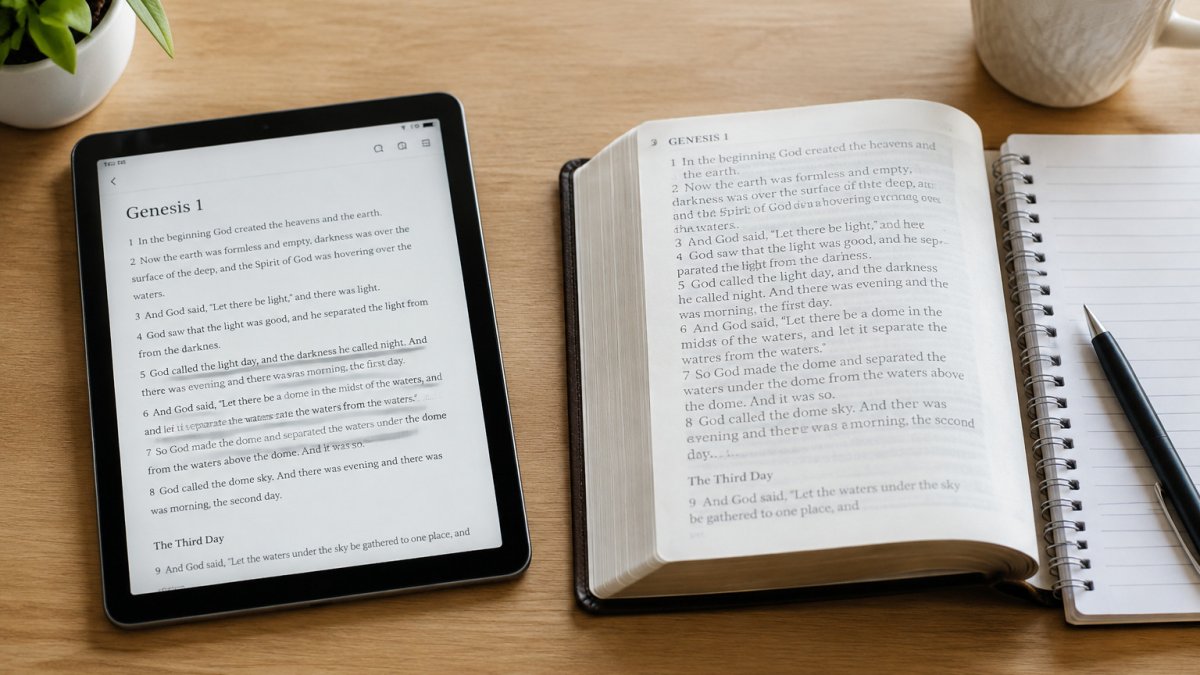
Quick Summary
A bible study plan for beginners works in either format: online plans offer search, reminders, and audio, while printed plans offer a distraction-free page and room for notes. Choose the format you are least likely to abandon, and keep it for at least a month before deciding whether to switch.
- Online plans provide automatic reminders, search, audio reading, and offline access.
- Printed plans reduce distractions and provide margins for handwritten notes.
- A hybrid approach uses an online plan for reminders and a printed journal for reflection.
- Keep the reading length fixed, such as one chapter per day, to make the habit manageable.
- Stick with one format for at least a month before deciding whether to switch.
Table of Contents
- Online vs Print Bible Study Plans: How They Differ for Beginners
- Pros and Cons of Online Bible Study Plans
- Pros and Cons of Printed Bible Study Plans
- How to Choose the Right Format: A Decision Framework for Your Learning Style and Routine
- Start Your Bible Study Plan: A Sample Beginner Plan in Either Format
- Guide to Reading the Bible for Beginners: Next Steps Once You Begin
- Frequently Asked Questions
Online vs Print Bible Study Plans: How They Differ for Beginners
Last Updated: November 14, 2026
Choosing a Bible study plan for beginners online vs print is one of the first real decisions a new reader faces. Online plans offer speed and search, while printed plans give a fixed, distraction-free page.
Online plans usually deliver one reading per day through an app, email, or website, and they update automatically. Print plans give you a booklet or printed Bible with the schedule laid out in advance.
Pros and Cons of Online Bible Study Plans
Online plans are easy to start: you can sign up, pick a schedule, and begin reading within minutes. Many are free, and directories such as the Bible Study Tools reading plan directory let you browse plans by length and reading order. The format's real strength, though, is not speed, it is the built-in scaffolding that helps a beginner keep going when motivation dips.
The main advantages are:
- Search and cross-reference. Looking up a name, phrase, or parallel passage takes seconds, which matters when a beginner hits an unfamiliar reference and wants context without leaving the page.
- Automatic reminders and catch-up. Daily readings arrive by email or notification, and most apps let you tap a missed day and resume without rebuilding the schedule.
- Portability and audio. Your plan travels with your phone, and many apps read the passage aloud, useful for commutes, chores, or anyone who absorbs Scripture better by ear.
- Adjustable text. Font size, line spacing, and light or dark backgrounds can be changed on the fly, which helps readers with low vision or screen sensitivity.
- Offline access. Many apps let you download a translation for reading without a signal, so a flight or a dead zone does not have to break the streak.
The drawbacks are real and worth naming before you commit:
- Notification competition. A reading reminder sits in the same tray as messages, email, and social apps, and it is easy to dismiss it without reading. If you choose online because of reminders, check that notifications will not be swiped away unread.
- Skim temptation. A screen invites scrolling, and beginners often finish a passage without absorbing it. Reading in a dedicated app rather than a browser tab helps.
- Cost opacity. Some plans are free, some require a subscription, and some bundle a plan with a paid translation or commentary. Pricing varies across providers, so confirm current costs on each provider's site before committing.
- Account and setup friction. Most apps require an account, and switching devices or translations can mean re-downloading and re-configuring.
A common pattern among beginners is to start online for the reminders, then discover after a few weeks that they read more carefully when the phone is face-down. That is not a failure of the format, it is information about how you read, and it is worth acting on rather than pushing through.
Pros and Cons of Printed Bible Study Plans
Print plans reduce distraction in a way screens struggle to match: a printed page does not send alerts, and many readers find they focus more on a physical book. Printing a PDF from a free source, such as the Navigators one-year reading plan(https://www.navigators.org/resource/bible-reading-plans/), gives you a schedule on paper, though you will need to supply the Bible itself.
The advantages include:
- Fewer distractions. The page shows only the text, and there is no tab, banner, or badge competing for attention.
- Handwriting space. Margins, a journal, or a printed worksheet give you room to underline, annotate, and date your reflections, something a phone screen rarely accommodates well.
- Easy navigation by feel. A physical Bible with tabs or a ribbon lets you flip to a passage without unlocking anything, and many readers find the location of a book easier to remember than a menu path.
- No technical setup. There are no accounts, updates, or apps to manage, and nothing to re-learn if you switch devices.
- Works anywhere. No signal, no charger, no problem, useful for early mornings, travel, or quiet rooms where you would rather not bring a phone.
The drawbacks are equally concrete:
- Harder to search. Looking up a name or cross-reference means using a concordance or index, which slows down the kind of quick comparison an app handles instantly.
- The schedule does not adjust. If you miss a day, the printed page does not reschedule it for you; you either fall behind or draw a line through the missed date and move on.
- Printing and supply costs. A free PDF still costs paper and ink, and a bound journal or study Bible is a purchase. These costs are modest but real, and they are easy to overlook when comparing formats.
- Updating means reprinting. If you change plans or want a different reading order, you print again or buy a new booklet.
A hybrid workflow gets the best of both without duplicating effort: use an online plan for the daily reminder and the reading order, and keep a printed worksheet or journal beside your Bible for reflection. The digital side handles scheduling and catch-up; the paper side handles attention and notes.
How to Choose the Right Format: A Decision Framework for Your Learning Style and Routine
Start with two questions. How do you concentrate best? And when during the day will you actually read? Answer those honestly, and the choice usually becomes clear.
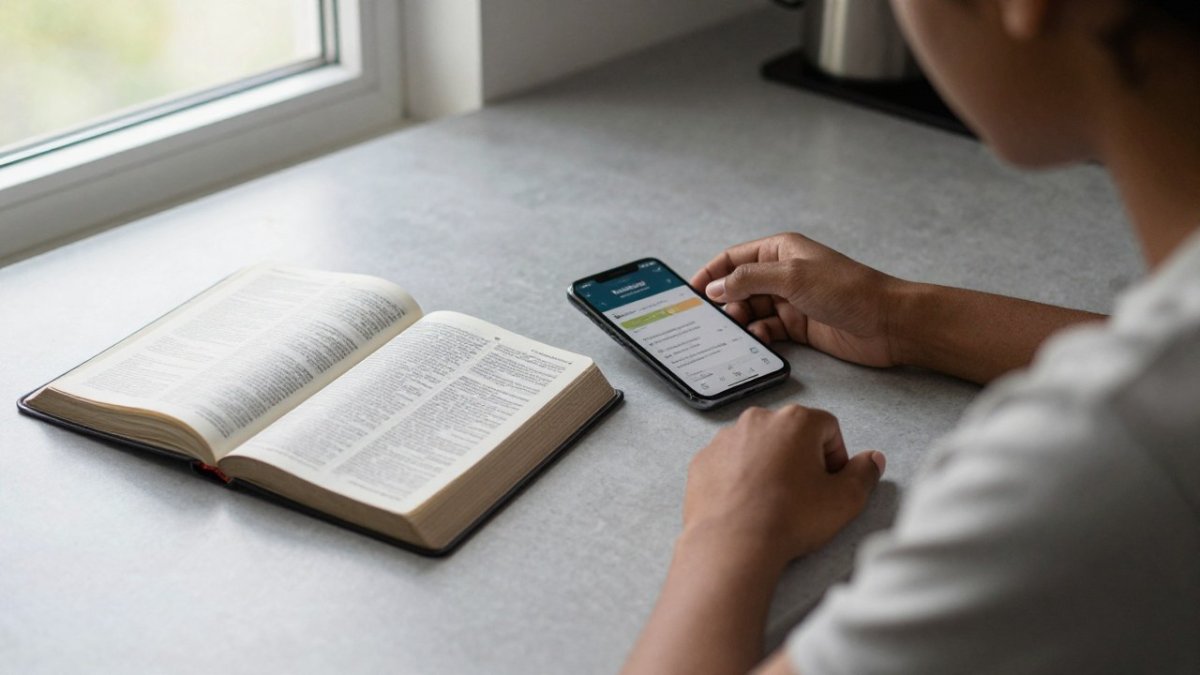
Use this simple guide:
| If you... | Lean toward |
|---|---|
| Read best with minimal screens | |
| Read on the commute or during breaks | Online |
| Want to search and compare passages often | Online |
| Like to annotate and return to notes | |
| Need reminders to keep a habit | Online |
| Want a plan with no setup or account |
A hybrid approach also works. Some readers use an online plan for daily reminders and a printed Bible for close reading. This keeps the habit visible without relying on a screen for the full experience.
Watch out: if you choose online because of reminders, check that notifications will not be dismissed without reading.
Start Your Bible Study Plan: A Sample Beginner Plan in Either Format
A beginner plan works best when it is short and specific. Here is a sample structure you can use in either format.
Week 1: Read one chapter per day from the Gospel of Mark. Spend five minutes afterward writing one sentence about what stood out.
Week 2: Read one chapter per day from Genesis, starting with chapter 1. Note any passage you want to revisit.
Week 3: Repeat the reading rhythm, moving through the next chapters at the same pace.
In print, write the dates beside each chapter. Online, set a daily reminder for the same time. Either way, keep the reading length fixed so the habit stays manageable.
Guide to Reading the Bible for Beginners: Next Steps Once You Begin
Once the first few weeks are done, review what you have read. Ask whether the daily length still feels right, and adjust it if reading feels rushed. Many readers move from short daily passages to longer sections after a month.
For a fuller introduction, the Ligonier reading plans collection(https://www.ligonier.org/posts/bible-reading-plans) gathers several published schedules you can compare. Keep your chosen format for at least a month before deciding whether to switch. Consistency matters more than the format itself.
Frequently Asked Questions
Is it better to study the Bible online or with a printed plan?
Neither format is better for everyone. Online plans make it easy to change pace, jump between passages, and read on a phone, while printed plans keep you away from notifications and make it simple to write notes in the margins. Beginners who struggle with screen fatigue or distraction often do better in print, and those with a busy schedule who read on the go often prefer digital. Many readers use a hybrid approach: a printed plan for daily reading and an online tool for cross-references and background notes.
Can I use a PDF Bible study plan on my phone?
Yes. A PDF plan opens on most phones and tablets, and you can keep it alongside your Bible app so you can check the day's readings without switching tabs. The trade-off is that PDFs are fixed layouts, so text can be small on a phone screen. Zooming or landscape mode usually solves this. If you plan to write notes, a tablet or a printed copy is more comfortable than a phone.
Where can beginners find a free printable Bible reading plan?
Several published plans are available as free downloads, and Bible study websites often list chronological, book-order, and one-year plans. Check whether a PDF is free before you download, since pricing is not always stated on the page. Before printing, confirm the plan's length and reading pace match how much time you have each day, because a plan that is too long is the most common reason beginners stop reading.
How long should a beginner Bible study session be?
Most beginners do well with 10 to 20 minutes a day, which is enough to read one chapter or a short passage and reflect on it. Shorter sessions are easier to maintain than long weekend sessions. If a plan assigns more reading than you can finish in that time, consider splitting the day's reading across two sittings, or choose a plan with shorter daily portions. Consistency matters more than length at the start.
